Best Budgeting Methods to Manage Your Money: The Complete Guide (2026)
The first and foremost step in achieving many financial goals is budgeting. Budgeting can enable income tracking, expense control, and the realization of financial dreams. If you want to buy a house, get out of debt, build an emergency fund, or simply improve your general financial habits, the place to start is with a budget.
Budgeting is often thought of as giving up everything that a person loves. A good budget allows you to take control of your money and spend on the things that really matter. It does not have to change your lifestyle but rather makes you make smart money choices that help your bottom line in the long run.
This guide will assist you in learning the best methods of managing money, in which you will know the working of each system and at the same time be able to choose the one that fits your life style.
Disclaimer: This article is for educational purposes only. It is not financial, investment or tax advice. Your money situation is different. Consider working with a qualified financial professional; important financial decisions shouldn’t be made alone.
Budgeting Matters
Budgeting will show you exactly how much you make and how much you spend. No more wondering where your money went each month. You will know what you make, what you spend, what you save, and what you invest. Benefits of Budgeting: More control of your money. Less wasteful expenditure. Saving made easier. Less money stress. Improved financial planning. Emergency preparedness planning. More confident in handling money.
Smart personal finance starts with budgeting.
1. The 50/30/20 Budgeting Method
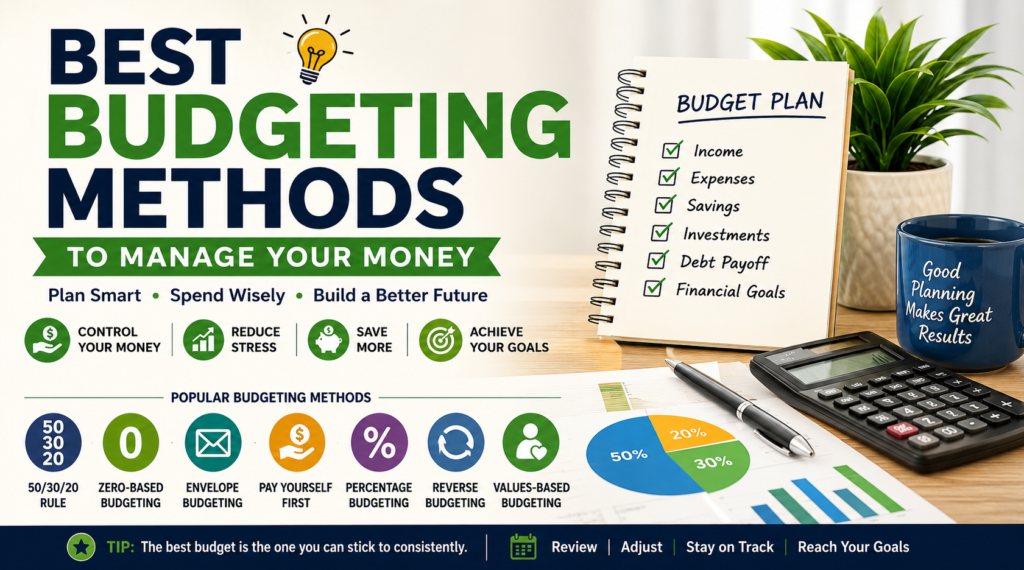
The 50/30/20 Rule is one of the most straightforward methods of budgeting for beginners. It divides your after-tax income into three parts:
50% for needs: housing, food, transportation, utilities — all of it.
30% for wants: fun, eating out, hobbies, travel, whatever.
20% for savings, investments or debt payoff.
This is an easy-to-understand plan that works well for many households because it creates a fair way of spending and saving.
Zero-Based Budgeting
Zero-based budgeting is when you give every dollar of your income a job until your income minus your planned expenses equals zero. That money can be allocated to housing, food, transportation, insurance, savings, investments, and entertainment. This method promotes purposeful spending and reduces unnecessary costs.
Budgeting Envelope System
The envelope budgeting method is meant to keep spending in check for specific categories. Normally, cash is divided into separate envelopes for the following expenses:
Food & Groceries Eating out Food Transport Shopping Entertainment
When an envelope is empty, the spending in that category stops until the next budget period.
Many budgeting apps today use digital versions of this system.
4. First, Save Up
It’s about putting your savings before anything else you might do with the money you have. For example:
- As soon as you get your income, put some into savings.
- Pay your bills.
Put the remaining amount of money into investment. This helps you build up savings consistently over time. Some people like to allocate personal percentages to what they want their money to do. You may want to adjust the percentages based on your income and priorities.
Reverse budgeting
With reverse budgeting, the emphasis is on the savings goal.
First, save a set amount and then use the balance to pay the priority bills. This is for those who are already good at managing their money but want to focus more on saving.
Values-Based Budgeting
Value-based budgeting is the type of budgeting that allows and motivates you to spend on the most important things to you or your family and to spend less on things that are not so important. For instance, in value-based budgeting the following items may receive a greater share of the budget:
AI-written text:
- Training
- Family-related activities
- Health
- Travel
- Growth and self-development
This type of funding would give an incentive to spend with a goal, not to try to save.
Ways to Select the Finest Budgeting System
There is not a universal method of budgeting. When deciding on the finest budgeting method, take into account your monthly income, financial goals, spending habits, family size, lifestyle and savings goals. The finest budget is the one you can stick to.
First-Timer Budgeting Tips New to the whole budgeting game? Here’s some easy advice to get you started: Keep a record of all your spending. Set reasonable limits on your spending. Review your budget monthly. Spend before you save. No random impulse buys. 2. Set up an emergency fund . Create reasonable financial goals. Keep an eye on your subscriptions. It’s better to be regular than perfect. Slip-Ups That Can Wreck Your Budget Many folks find it hard to stick to a budget because they fall into these traps:
- Not tracking expenses
- Setting unrealistic budgets
- Forgetting irregular costs
- No emergency savings
- Spending moods
- Throwing in the towel too soon
- Not checking the budget regularly
Mistakes that can help you change your money habits over time.
Tools Available for Budgeting
Today, digital tools are available to manage your money easily.
Here are some popular choices:
- Spreadsheet templates
- Budgeting applications
- Banking expense trackers
- Personal finance software
- Tools to budget in the moment
Choose a tool you like and will actually use.
Creating Stronger Money Habits
Budgeting is only a component of the greater financial management. Other better money habits comprise on-time bill payments, consistent saving, staying away from unnecessary debts, monitoring spending, planning for large purchases, reviewing financial goals, and learning about personal finance. The small daily decisions you make can have a large impact on your money over time.
Closing Thoughts
Your budget is one of your most powerful financial weapons. It doesn’t matter whether it’s the 50/30/20 Rule, Zero-Based Budgeting, Envelope Budgeting, or some other method. The secret is to do it, and do it, and do it.
Remember, budgeting should not be taken as a means through which you will have to cut your life. It is to provide education that will equip you to make intelligent money decisions to achieve your goals and reduce money stress. By monitoring your income, controlling your spending, saving money and regularly reviewing your budget, you can build better money habits and move towards a more financially secure future.
Adhere to the 50/20/30 rule and make changes according to the alterations in your income. These are little steps, but they can help you feel in control, bring stability, and let you slowly move toward success.